Russian diesel deal: first 300,000 tonnes equal 14 hours of U.S. demand; diesel by state
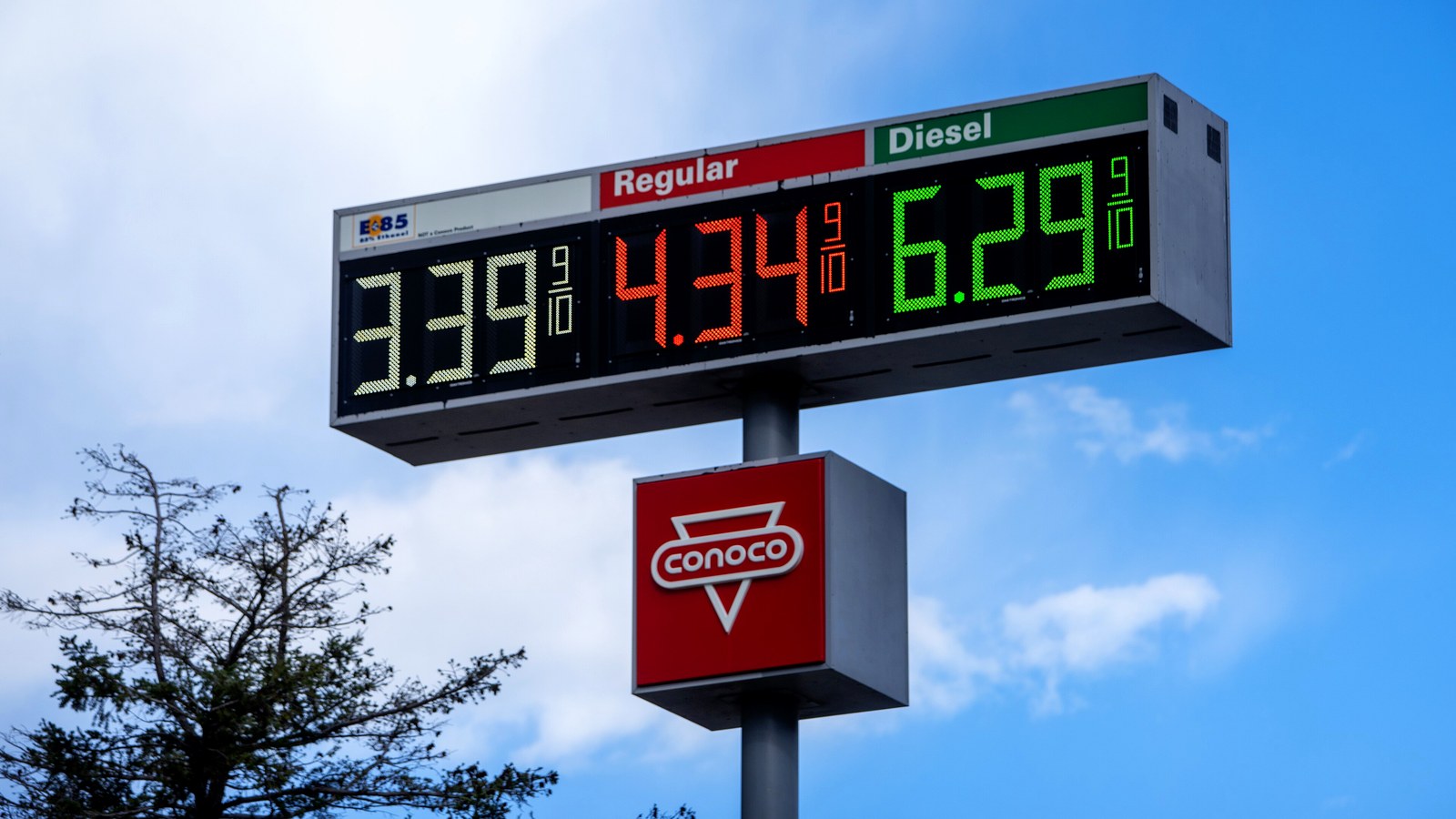
On October 9 President Trump said Russia would supply more than 300,000 tonnes of diesel "immediately", 500,000 tonnes in November and more after that, and the Treasury issued a license allowing Russian diesel to be sold and imported into the U.S. until April 2027. Diesel futures fell 4.6% that day. At the pump, little has changed: AAA's national diesel average is $6.279 on Tuesday, up 1.2 cents on Monday and 3.6 cents below a week ago. We converted the promised tonnes into barrels: the first batch equals about 14 hours of U.S. diesel use. The EIA's first weekly diesel price since the deal comes out on Wednesday, October 14.
Will the Russian diesel deal lower diesel prices?
Not by much, and not soon. The promised volumes are small next to U.S. and world demand, none has been confirmed on its way to a U.S. port, and the futures drop it caused was already shrinking on Tuesday.
AAA's national average for diesel is $6.279 a gallon on Tuesday, October 13, against $6.267 on Monday, $6.315 a week ago and $3.653 a year ago. The all-time high was $6.528 on September 22. Filling a 150-gallon truck tank costs about $942, roughly $394 more than in October 2025.
The U.S. Energy Information Administration's weekly survey, the figure this site and most fuel surcharges use, put on-highway diesel at $6.199 for the week of October 5, down 18.3 cents from the week before and 33 cents below the record $6.529 of September 21. Because of Columbus Day, the next weekly figure, for Monday, October 12, comes out on Wednesday, October 14. It will be the first EIA diesel price since the deal. We will update this page when it is published.
Yesterday we looked at gasoline and the "energy ceasefire" in gas prices this week. This page is about diesel: what the license allows, how much fuel is involved, when it could arrive and what diesel costs in each state today.
AAA national diesel average, October 13; $6.315 a week ago
ULSD futures on the day of the announcement, October 9 (DTN)
U.S. distillate stocks on October 2, 13.5% below a year earlier (EIA)
the EIA's forecast average for diesel from October to December, in its outlook of October 6
What General License 135 allows, and what it does not say
The only U.S. government document behind the deal is a one-page Treasury license. It removes a legal barrier. It does not buy, ship or price any diesel.
The Treasury's Office of Foreign Assets Control (OFAC) issued Russia-related General License 135 on Friday, October 9, signed by its director, Bradley T. Smith. It authorizes transactions otherwise banned under two sets of Russia sanctions regulations that are "related to the sale, delivery, offloading, or importation, including importation into the United States, of diesel fuel of Russian Federation origin". It runs until 12:01 a.m. Eastern time on April 7, 2027. The U.S. has not imported Russian oil or gas since 2022, according to the EIA as cited by AP, so this is the first legal route for Russian diesel into the country since then.
The license has one exception: it does not authorize any debit to an account at a U.S. financial institution held by Russia's central bank, its National Wealth Fund or its Ministry of Finance. In practice, payments can't come out of the Russian state's frozen money in the U.S.
| Question | What the license says |
|---|---|
| Which fuel? | Diesel fuel of Russian origin only. Not crude oil, not gasoline, not jet fuel |
| Which activities? | Sale, delivery, offloading and importation, including into the United States |
| Until when? | 12:01 a.m. EDT, April 7, 2027 |
| How much? | No volume. The tonnes come from the President's post, not from the license |
| Who buys? | Not stated. No U.S. agency is named as a buyer and the license does not oblige anyone to buy |
| Only cargoes already loaded? | No such condition appears in the text, although some early reports said it covered only diesel loaded by October 9 |
| What is excluded? | Debits to U.S. accounts of Russia's central bank, National Wealth Fund or Ministry of Finance |
How much diesel, in barrels and in days of U.S. demand
Diesel is traded in tonnes abroad and in barrels in the U.S. Converted, the whole package announced would cover less than ten days of U.S. diesel use, spread over several months.
| Batch announced | Barrels | U.S. demand covered | When, per Trump / Moscow |
|---|---|---|---|
| 300,000 tonnes | 2.2 million | 14 hours | "Immediately" / from October |
| 500,000 tonnes | 3.7 million | 1 day | November |
| 1,000,000 tonnes | 7.5 million | 2 days | "Immediately thereafter" / December |
| 3,000,000 tonnes | 22.4 million | 6 days | "Within a short period of time", depending on Russian refineries |
| Total, 4.8 million tonnes | 35.8 million | 9.5 days | Over several months, not dated |
Our calculation: 7.45 barrels per tonne of diesel, the conversion S&P Global uses (as cited by FreightWaves), against U.S. distillate fuel demand of 3.769 million barrels a day, the EIA's four-week average to October 2. Batches and wording as posted by the President on October 9 (via AP and Interfax); the October and December timing is Russian Deputy Prime Minister Alexander Novak's, as reported by AFP. None of these volumes appears in a U.S. or Russian legal document.
Moscow has so far authorized 500,000 tonnes. On October 10 the Russian government partly lifted its diesel export ban, effective that day, to allow "at this stage" 500,000 tonnes onto the world market, and told oil companies to start contracting with foreign buyers in coordination with the government. Russia had banned diesel exports by non-producers since January 31 and extended the ban to refiners themselves on July 9.
Not all of it is meant for the U.S. The President's post spoke of supplying "the American and global marketplace", and the Treasury described the license as allowing Russian diesel "to the global market". The U.S. is itself the world's largest diesel exporter: it shipped out 1.76 million barrels a day of distillates in the week to October 2, against imports of 118,000 barrels a day (EIA). The first 300,000 tonnes equal about a day and a quarter of U.S. distillate exports.
Against what Russia used to sell, it is a fraction. Russian diesel and gasoil exports averaged 850,000 barrels a day in the first quarter and 190,000 in the third, according to Vortexa data cited by Windward analyst Michelle Wiese Bockmann to Al Jazeera. The 500,000 tonnes now cleared work out at about 124,000 barrels a day if shipped over a month. The International Energy Agency says Ukrainian strikes have cut Russian diesel output by about 30% (AP), and Neil Atkinson, a former head of the IEA's oil markets division, told Al Jazeera that in the short term Russia could only deliver the promised volumes by taking diesel from its own domestic market.
When Russian diesel could arrive, and when the pump would show it
Three clocks run one after another: contracting and loading in Russia, two to three weeks at sea, and then several weeks for a wholesale drop to reach the pump.
1Contracts and loading
Russian companies were told on October 10 to start contracting "immediately". Novak told the TASS news agency that supplies to the U.S. could start in October (AP). No cargo bound for a U.S. port had been confirmed by an official source as of October 13.
2At sea: about 2 to 3 weeks
Russia's main diesel export ports are on the Baltic and the Black Sea. On our estimate from distance and typical tanker speeds, a cargo from the Baltic needs about two and a half weeks to reach the U.S. East Coast, longer from the Black Sea. A tanker loaded in mid-October would land around early November, close to Election Day on November 3.
3Wholesale to pump: weeks more
U.S. diesel imports go mostly to the East Coast, where New York Harbor sets the ULSD benchmark. Michael Lynch of the Energy Policy Research Foundation told AP the best case is a small local dip around New York, New Jersey and Philadelphia. Any easing in wholesale prices then takes weeks to reach the national pump average: see the table below.
| Weeks after the move | Share of a wholesale fall at the pump | Share of a rise | A 22.7¢ wholesale drop becomes |
|---|---|---|---|
| 1 week | 14% | 67% | −3¢ |
| 2 weeks | 42% | 77% | −10¢ |
| 3 weeks | 50% | 83% | −11¢ |
| 4 weeks | 65% | 80% | −15¢ |
| 6 weeks | 79% | 85% | −18¢ |
| 8 weeks | 94% | 91% | −21¢ |
Our calculation: a regression of the weekly change in the EIA's U.S. on-highway diesel price (Mondays) on the changes in the EIA's U.S. Gulf Coast ultra-low sulfur diesel spot price, weekly averages of the previous eight weeks, rises and falls measured separately; 614 weeks, January 2015 to October 5, 2026; it explains about 70% of weekly moves. Using the New York Harbor spot price instead gives similar shares. The last column applies the shares to Friday's 22.7-cent futures drop as if it had lasted, which it has not.
Rises reach the diesel pump about five times faster than falls in the first week, a stronger version of the pattern we measured for gasoline. Unlike gasoline, though, diesel stations are not short of margin right now: the gap between the national diesel price and the previous week's Gulf Coast wholesale price was $1.47 on October 5, in line with its 2026 average of $1.45. So a lasting wholesale drop would likely pass through at the normal pace, with nothing held back to rebuild margins.
Why the deal matters for diesel and hardly at all for gasoline
This year's price shock hit refining harder than crude, and refining is where Russia, diesel and the deal meet.
New York Harbor ULSD over the cost of the crude in it on October 2 (EIA spot prices); 82¢ a year earlier
the same gap for gasoline; 40¢ a year earlier
diesel over regular in the EIA's survey on September 21, the widest in its weekly data since 1994; the 2015–2025 average was 45¢
share of the retail diesel gallon that was crude oil in May 2026, against 52% for gasoline; refining took 25% of diesel's price (EIA)
Diesel is short in a way gasoline isn't. Ukrainian drone strikes have knocked out Russian refineries, and Russia, until its export ban the world's second-largest diesel exporter after the U.S. (Al Jazeera), has had little to sell abroad, while the conflict with Iran has cut off refined products from the Persian Gulf. Supplies of refined products such as diesel are still only about half of their prewar level, Daniel Sternoff of Columbia University's Center on Global Energy Policy told AP. The result shows in the spot market: on October 2 a gallon of New York Harbor ULSD cost $2.34 more than the West Texas crude it is made from, against $1.07 for gasoline.
The license covers only diesel. Russian gasoline remains under U.S. sanctions, and Russia itself keeps its ban on gasoline exports until January 31, 2027 (EFE). Any effect on gasoline would come only through crude oil prices, and the deal adds no crude. That is why a gallon of diesel costs $1.94 more than regular at AAA today, against 57 cents a year ago and 87 cents in the EIA's survey of February 23, just before the war with Iran began.
U.S. stocks are thin. Distillate inventories were 105.1 million barrels on October 2, 16.4 million below a year earlier, even though U.S. refineries produced 5.17 million barrels a day of distillates over four weeks, more than a year earlier. Exports took 1.76 million barrels a day in the latest week. Low stocks make the price react faster to any news, including a political announcement, in both directions. Our red-dyed diesel guide covers the other relief measure for truckers and farmers, the federal penalty waiver of October 5.
Diesel prices by state today, cheapest first
All 50 states and D.C., with AAA's daily average, the change in a week, the EIA's weekly figure for the state's region and the state's own diesel tax.
| State | Diesel, Oct 13 (AAA) | 1 week | EIA weekly, Oct 5 | State diesel tax |
|---|---|---|---|---|
| Texas | $5.723 | −1.3¢ | $5.819 (Gulf Coast) | 20.0¢ |
| Georgia | $5.740 | −6.4¢ | $5.699 (Lower Atlantic) | 38.0¢ |
| North Carolina | $5.763 | −23.9¢ | $5.699 (Lower Atlantic) | 41.2¢ (suspended Oct 10–Nov 30) |
| Louisiana | $5.818 | −2.3¢ | $5.819 (Gulf Coast) | 20.9¢ |
| South Carolina | $5.824 | −0.3¢ | $5.699 (Lower Atlantic) | 28.7¢ |
| Oklahoma | $5.868 | +5.7¢ | $6.286 (Midwest) | 20.0¢ |
| Mississippi | $5.881 | −1.5¢ | $5.819 (Gulf Coast) | 24.4¢ |
| Arkansas | $5.912 | −4.7¢ | $5.819 (Gulf Coast) | 28.8¢ |
| Alabama | $5.933 | −1.4¢ | $5.819 (Gulf Coast) | 32.8¢ |
| Florida | $5.946 | +3.8¢ | $5.699 (Lower Atlantic) | 41.0¢ |
| New Mexico | $5.989 | −6.9¢ | $5.819 (Gulf Coast) | 22.9¢ |
| Missouri | $5.990 | −7.4¢ | $6.286 (Midwest) | 30.0¢ |
| North Dakota | $5.996 | −5.7¢ | $6.286 (Midwest) | 23.0¢ |
| South Dakota | $6.005 | +3.3¢ | $6.286 (Midwest) | 30.0¢ |
| Tennessee | $6.007 | −2.4¢ | $6.286 (Midwest) | 28.4¢ |
| Kansas | $6.008 | −1.5¢ | $6.286 (Midwest) | 27.0¢ |
| Nebraska | $6.032 | +4.5¢ | $6.286 (Midwest) | 32.1¢ |
| Ohio | $6.070 | −16.7¢ | $6.286 (Midwest) | 47.0¢ |
| Iowa | $6.075 | +2.4¢ | $6.286 (Midwest) | 32.5¢ |
| Montana | $6.106 | −8.9¢ | $6.267 (Rocky Mountain) | 30.5¢ |
| Kentucky | $6.117 | −6.6¢ | $6.286 (Midwest) | 23.4¢ |
| Minnesota | $6.134 | +0.5¢ | $6.286 (Midwest) | 32.7¢ |
| Wisconsin | $6.185 | −10.2¢ | $6.286 (Midwest) | 32.9¢ |
| Wyoming | $6.198 | +0.1¢ | $6.267 (Rocky Mountain) | 24.0¢ |
| Arizona | $6.205 | −2.3¢ | $6.490 (West Coast excl. Calif.) | 19.0¢ |
| Virginia | $6.216 | −3.6¢ | $5.699 (Lower Atlantic) | 43.5¢ |
| Utah | $6.302 | −13.1¢ | $6.267 (Rocky Mountain) | 38.6¢ |
| Delaware | $6.307 | −6.4¢ | $6.485 (Central Atlantic) | 22.0¢ |
| New Jersey | $6.324 | −3.7¢ | $6.485 (Central Atlantic) | 56.1¢ |
| Rhode Island | $6.326 | +1.9¢ | $6.476 (New England) | 41.1¢ |
| Massachusetts | $6.332 | −2.3¢ | $6.476 (New England) | 27.6¢ |
| New Hampshire | $6.352 | −1.5¢ | $6.476 (New England) | 23.8¢ |
| Idaho | $6.356 | −11.1¢ | $6.267 (Rocky Mountain) | 33.0¢ |
| Colorado | $6.358 | +29.2¢ | $6.267 (Rocky Mountain) | 35.7¢ |
| Maryland | $6.363 | −1.4¢ | $6.485 (Central Atlantic) | 47.7¢ |
| West Virginia | $6.365 | −3.7¢ | $5.699 (Lower Atlantic) | 35.7¢ |
| Vermont | $6.386 | −2.1¢ | $6.476 (New England) | 33.0¢ |
| Maine | $6.443 | −1.4¢ | $6.476 (New England) | 32.0¢ |
| Connecticut | $6.453 | −1.1¢ | $6.476 (New England) | 49.9¢ |
| Michigan | $6.481 | −11.1¢ | $6.286 (Midwest) | 53.4¢ |
| District of Columbia | $6.502 | −0.3¢ | $6.485 (Central Atlantic) | 35.7¢ |
| New York | $6.511 | −0.8¢ | $6.485 (Central Atlantic) | 22.4¢ |
| Pennsylvania | $6.545 | −0.6¢ | $6.485 (Central Atlantic) | 74.1¢ |
| Alaska | $6.563 | −1.6¢ | $6.490 (West Coast excl. Calif.) | 8.9¢ |
| Illinois | $6.570 | −9.3¢ | $6.286 (Midwest) | 79.2¢ |
| Indiana | $6.624 | −9.4¢ | $6.286 (Midwest) | 64.0¢ |
| Oregon | $6.753 | −4.2¢ | $6.490 (West Coast excl. Calif.) | 40.0¢ |
| Nevada | $6.761 | +1.4¢ | $6.490 (West Coast excl. Calif.) | 27.8¢ |
| Hawaii | $7.262 | +4.6¢ | $6.490 (West Coast excl. Calif.) | 18.5¢ |
| Washington | $7.282 | −4.8¢ | $6.490 (West Coast excl. Calif.) | 63.2¢ |
| California | $8.393 | +2.9¢ | $8.082 (California) | 92.9¢ |
AAA: daily state averages for diesel on October 13, 2026, and change against AAA's week-ago figure. EIA: weekly survey for the week of October 5. The EIA publishes a diesel average for California and for regions, not for other states; the region is named in brackets (West Coast means West Coast excluding California, and includes Alaska and Hawaii). State diesel tax: state excise and fees per gallon, as shown on our state pages (rates of July 2026); the 24.4-cent federal diesel tax comes on top.
Cheapest: Texas ($5.72), Georgia ($5.74) and North Carolina ($5.76), followed by Louisiana and South Carolina. The Lower Atlantic was the cheapest EIA region last week at $5.699, ahead of the Gulf Coast at $5.819. Most expensive: California at $8.39, then Washington ($7.28) and Hawaii ($7.26), with Nevada and Oregon above $6.75.
Two states set records today. AAA's highest-ever diesel averages for Colorado ($6.358) and Hawaii ($7.262) are both dated October 13. Colorado jumped 29.2 cents in a week, the biggest rise in the country; AAA does not give a reason, and Denver's EIA figures are on our Denver page. In 45 other states and D.C. the record dates from September, and today's price is up to 75 cents below it, about 20 cents in a typical state; in New York, Massachusetts and Rhode Island the record is still from May 2022.
North Carolina fell most, and not because of Russia. AAA's North Carolina diesel average dropped 23.9 cents in a week, after the state suspended its 41.2-cent tax on gasoline and diesel from October 10 to November 30. Ohio (−16.7¢), Utah (−13.1¢) and Michigan, Idaho and Wisconsin (all down more than 10¢) also fell. The Midwest, where farmers are bringing in the harvest, pays $6.29 on the EIA's figure. Our gas tax by state table shows each state's rates.
What to watch this week and next
The dates when each number that matters for diesel gets updated.
Wednesday, Oct 14: EIA diesel price
The first weekly figure since the deal, for Monday, October 12. AAA's daily average fell 3.6 cents over the past week, so a small decline from $6.199 would match it, though the two surveys differ. Our diesel prices page updates with it.
Thursday, Oct 15: diesel stocks
The EIA's weekly petroleum report, a day late because of the holiday, gives distillate stocks, demand, imports and exports for the week to October 9. Imports are where Russian diesel would first show up, though the EIA does not break them down by country weekly.
Cargo tracking and Moscow
Whether Russian companies sign contracts for the 500,000 tonnes cleared so far, and whether Moscow clears more in November as promised. Novak's December figure and the 3 million tonnes depend on Russian refineries, which Ukraine has kept attacking.
Washington
Senators of both parties want the license reversed; the Treasury can amend or revoke it at any time. Separately, the IEA asked its members on October 11 to speed up the emergency stock releases they pledged in March, with diesel first.
Timeline: the Russian diesel deal and the pump, updated October 13
Newest first. Times are U.S. Eastern unless stated.
- Thursday, October 15 (due)EIA weekly petroleum report for the week to October 9: distillate stocks, imports and exports.
- Wednesday, October 14 (due)EIA weekly diesel and gasoline prices for Monday, October 12, a day late because of Columbus Day.
- Tuesday, October 13AAA diesel average $6.279, up 1.2 cents; records in Colorado and Hawaii. ULSD futures at $4.82 mid-morning, up 9.5 cents.
- Monday, October 12ULSD futures settle about $4.72, a little lower, while crude rises about 2%. AAA diesel $6.267.
- Sunday, October 11Six senators of both parties ask the administration to "immediately reverse course". The IEA asks members to speed up stock releases, prioritizing diesel.
- Saturday, October 10Russia partly lifts its diesel export ban, clearing 500,000 tonnes for the world market. North Carolina's state fuel tax is suspended to November 30.
- Friday, October 9President Trump announces the deal after a call with President Putin. OFAC issues General License 135, valid to April 7, 2027. ULSD futures fall 22.7 cents to about $4.73.
- Tuesday, October 6EIA: diesel $6.199 for the week of October 5, down 18.3 cents. The EIA's outlook forecasts $5.81 for the quarter.
- Monday, October 5Executive order waives the federal penalty for red-dyed diesel on highways through December 31.
- September 21–22Diesel records: $6.529 in the EIA's survey, $6.528 at AAA.
- July 9Russia extends its diesel export ban to refiners.
Gas prices this week and the 'energy ceasefire'
What oil's brief drop meant for gasoline, and how fast it reaches the pump
Diesel prices this week
The EIA's national diesel average, region by region
Red-dyed diesel on highways
What the federal waiver covers, the state waivers and the tax you still owe
Gas and diesel prices by state
Every state's weekly EIA average for regular and diesel, with its fuel tax
Why are gas prices so high?
This week's gallon split into crude, refining, taxes and margin
Gas tax by state
The part of the price that does not move with oil or diesel deals
Where these figures come from
The license text from the Treasury, Russia's decision from its government, prices and stocks from the EIA and AAA, futures and statements as reported by the outlets named. Conversions, days of demand and the pass-through analysis are ours.
- Office of Foreign Assets Control, Russia-related General License 135, "Authorizing Transactions Related to the Sale, Delivery, Offloading, and Importation of Diesel Fuel of Russian Federation Origin", October 9, 2026 — ofac.treasury.gov
- Government of the Russian Federation, "The Government has partially lifted the ban on diesel fuel exports from Russia", October 10, 2026 (in Russian) — government.ru
- U.S. Energy Information Administration, Gasoline and Diesel Fuel Update, release of October 6, 2026 (week of October 5; next release October 14), and what we pay for in a gallon of diesel, May 2026 — eia.gov; weekly U.S. on-highway diesel series — eia.gov
- EIA Weekly Petroleum Status Report, release of October 7, 2026 (week ending October 2): distillate stocks, production, product supplied, imports and exports — eia.gov
- EIA spot prices, ultra-low sulfur No. 2 diesel, U.S. Gulf Coast and New York Harbor, daily and weekly to October 6, 2026 — eia.gov; EIA Short-Term Energy Outlook, October 6, 2026 — eia.gov
- AAA national and state diesel averages and record prices, October 13, 2026 — gasprices.aaa.com
- The President's post of October 9, the Kremlin statement, Novak's remarks to TASS and the IEA output estimate, as reported by the Associated Press via NPR and Interfax; Novak's monthly schedule as reported by AFP; Russia's gasoline export ban as reported by EFE
- Analysts' comments: Daniel Sternoff and Michael Lynch to AP, via Fortune; Vortexa export data, Neil Atkinson and Russia's export ranking, Al Jazeera
- ULSD futures: DTN, October 9 and October 12; FreightWaves, October 13 (also the tonnes-to-barrels conversion and the IEA statement of October 11)
- The senators' statement of October 11, as reported by AP via PBS NewsHour
- State and region diesel prices and state diesel taxes: this site's EIA-based pages, week of October 5, 2026 — where the numbers come from
Published
By Gas Price Radar newsroom
We publish the U.S. Energy Information Administration's weekly gas and diesel prices for every state, region and city, and we measure how changes in oil and wholesale prices reach the pump.
Sources: Office of Foreign Assets Control, Russia-related General License 135 of October 9, 2026 (license text); Government of the Russian Federation, decision of October 10 partly lifting the diesel export ban; U.S. Energy Information Administration (Gasoline and Diesel Fuel Update of October 6, Weekly Petroleum Status Report of October 7, spot prices); AAA national and state averages for October 13, 2026. The President's post, statements and analysts' figures as reported by AP, Interfax, AFP, Al Jazeera, DTN and FreightWaves. Barrel conversions, days of demand and the pass-through analysis are our own calculations on EIA data. Photo: Tony Webster, CC BY 4.0, via Wikimedia Commons. How our prices work: Where the numbers come from.